I’m sure most of you are scratching your heads like I did the first time I heard about this concept but after reading this article by business week it should make more sense.
Fail Fast, Fail Cheap
Get your idea into the marketplace, and learn from customers
by Doug Hall
The development of a successful new product, service, or business is often the result of lots of learning from lots of failures. The key is to fail fast and fail cheap.
The classic mindset is to try to get a business plan or product 95% right before taking action. This is great in theory, but it rarely works. Why? Because as soon as you ship the product you immediately recognize its fatal flaws. By then, it’s often too late to change the packaging, the marketing, or the product itself.The alternative is to get your idea about 50% right, then let customers tell you what your mistakes are. Listen, learn, get it 50% right, and put your idea through the process again. Keep at it until your customers say, “Wow!” Instead of debating options internally, you’ll be making your idea real, taking it to customers, and learning as it fails.
You can make an idea real by producing a “looks like” or “works like” prototype and showing it to customers. A “looks like” prototype can be as simple as a fact sheet or a sales letter e-mailed to friends or potential buyers. “Works like” prototypes are demonstrations. They don’t have to be pretty. They just need to show the overt benefit you are promising.
The power of a “works like” prototype can be immense. I observed this recently in the boardroom of an industrial products company. A young engineer demonstrated how his prototype could cut the noise level of the company’s equipment by 70%. The prototype was made from duct tape and other materials from a hardware store. But it was effective enough to win funding for its development. Thanks to that idea, the company is projecting 20% sales growth this year.
I am not encouraging you to fail. Rather, I am stating the fundamental truth that you can’t know the answers before you start. It’s foolish to assume you know things that it’s not possible to know.
We preach to our children the need to pick themselves up and try again and again when they fail. But we rarely live by our own preaching, continuing to view failure as a statement of our self-worth. And while we may complain about how long it takes to move ideas through our companies, we inspect and edit with gusto whenever a new idea passes through our finance, marketing, or legal departments.
Over the years we’ve failed fast and cheap on behalf of clients in restaurants, at medical trade shows, in convenience stores, in malls, and at conventions. And I don’t just promote the virtues of failing fast and cheap to clients; I do it myself. When I was thinking about entering the training business, I rented two booth spaces at a major industry trade show. Each was completely different, with different brand names, product offerings, and pricing. The “right” answer ended up to be a combination of ideas from each.
The math of fail fast and fail cheap is simple. If it takes six months and $100,000 to take a product from idea to customer reaction, then at best you’ll get two cycles in a year. However, if you can do a complete cycle of learning in a week for $1,000, you can get 52 cycles in a year at about half the cost.
The only barrier to failing fast and failing cheap is your ego. You must be willing to fail, fail, and fail again if you are going to win in today’s competitive marketplace. Remember, even if you’re falling flat on your face, at least you’re still moving forward.
You really just have to put yourself out there and be willing to change. Saying no failure is the same as saying no to success.
Need an E-Commerce Website?
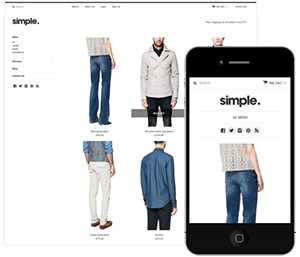 Shopify is perfect for beginners and experts. You don't need to have any technical or design experience to easily create a beautiful online store with your branding. Choose from tons of well designed e-commerce templates that look great on desktops, phones, and tablets. Easily customize, create pages, add products, and you're pretty much ready to accept payments. Plans come with a free no risk 30 day trial period.
Check out our in depth review of Shopify here and see why Shopify is our number 1 recommended shop for clothing companies.
Shopify is perfect for beginners and experts. You don't need to have any technical or design experience to easily create a beautiful online store with your branding. Choose from tons of well designed e-commerce templates that look great on desktops, phones, and tablets. Easily customize, create pages, add products, and you're pretty much ready to accept payments. Plans come with a free no risk 30 day trial period.
Check out our in depth review of Shopify here and see why Shopify is our number 1 recommended shop for clothing companies.